
 jjyixin
Multicolor UV Curing Printing Technology: Development, Principles, and Advantages
(1) Development History
1970 – Introduced
Early 1980s – 10% UV ink / no UV varnish
Early 1990s – Slow development of UV inks; interest in UV varnish increased
1996 – Rapid development of UV inks and varnishes
2000 – UV inks and varnishes widely used in metal printing
2004 – Began to replace traditional printing methods
(2) The proportion of UV tinplate inks versus traditional inks worldwide (2005 statistics) is shown in Figure 3-26.
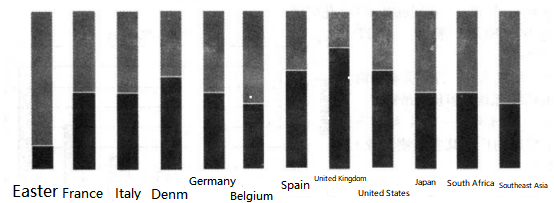
Figure 3-26 Ratio of UV iron printing ink to traditional ink around the world (2005 statistics)
■UV■Traditional
It can be seen that UV tinplate printing technology is already very widespread abroad.
(3) Curing principle Unlike traditional oven drying, UV curing mainly relies on UV curing equipment. Under ultraviolet light (UV) with a wavelength of approximately 180–420 nm, the base materials (photocurable resins) in the ink and varnish undergo polymerization and cross-linking reactions in the presence of a photoinitiator. This reaction rapidly opens the unsaturated double bonds in a very short time, curing the ink and varnish into macromolecules.
(4) Advantages of UV printing technology
① Environmental protection: No volatile organic compounds (VOC) are emitted, so it does not pollute the environment; heating for drying is unnecessary, reducing large amounts of exhaust.
② Energy saving: Without the need for oven drying, gas costs are reduced.
③ Space and maintenance savings: No ovens are required, saving about 50% of the printing floor space and reducing daily maintenance, repairs, and cleaning costs, thereby improving production efficiency.
④ High speed: Instant drying allows for multi-color printing.
⑤ Improved product quality: Reduces scratches caused by holding frames.
(5) Applicable product types
UV inks can generally be used for beverage cans, aerosol cans, food cans, crown caps, and similar products. However, UV varnish currently has some restrictions on beverage and food cans. For two-piece cans with very deep drawing, UV inks and varnish still need further solutions to prevent peeling.
(6) Physical and chemical properties of products
For beverage cans, aerosol cans, food cans, crown caps, and similar products, the color, adhesion, scratch resistance, hardness, and other properties of UV inks and varnish are generally comparable to traditional inks and varnishes.
(7) Current domestic situation
Currently, companies such as COFCO Packaging and Shanghai Baocai have this technology in China
 jjyixin
 jjyixin